Astra and Codex for exoplanet hunting: what changes for an amateur using public Kepler and TESS data
OpenAI reports two amateur astronomers used Codex and Astra to search public Kepler and TESS data for potential exoplanets. Here is what that changes in practice and what still needs checking.
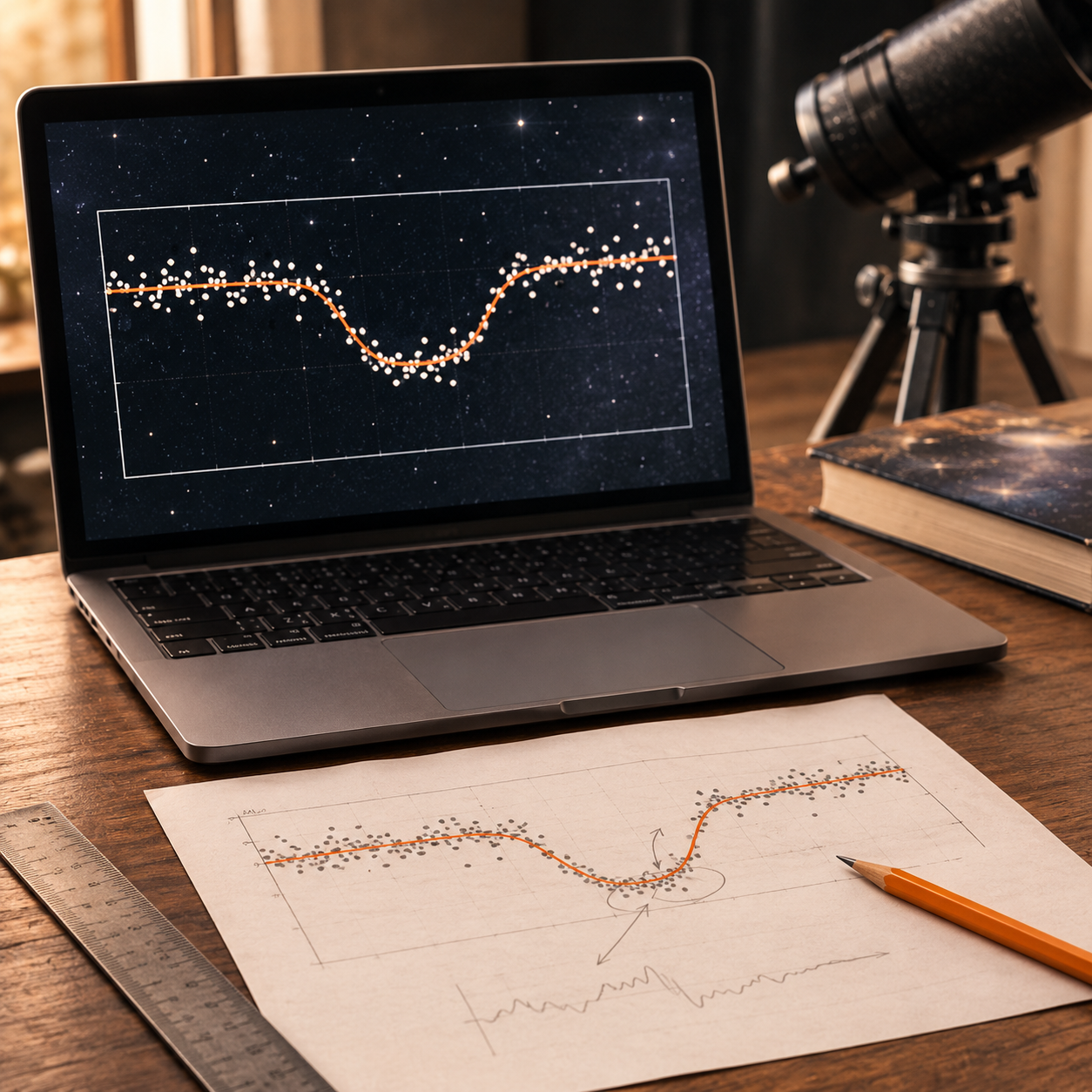
What does the announcement actually change for someone who wants to search for exoplanets in public NASA Kepler and TESS data? According to OpenAI, in a post published on November 24, 2026, two amateur astronomers used Codex and Astra to look for potential exoplanets in public data from those missions. That is the confirmed fact from the source. The source does not claim the tools guarantee a discovery; it presents an example workflow. Below is how to assess that workflow on a small sample and which details remain open.
What is confirmed and what is still a suggestion
Confirmed: OpenAI describes two amateurs using Codex and Astra to search public Kepler and TESS data for potential exoplanets. Not confirmed: specific model versions, prices, availability, accuracy on an independent sample, reproducibility, or the status of any candidates. Treat the case as an example of a process, not as proof of effectiveness.
A concrete workflow for your task
- Pick a narrow slice of data. Choose one TESS sector or a small Kepler light-curve segment, not the whole archive.
- Fix your criteria first. Define what counts as a candidate: periodicity, transit depth, absence of obvious artifacts.
- Use Codex to draft code. Have it write a script to read files, smooth the curve and flag periodic dips; then review the code manually.
- Use Astra to explain and cross-check. Compare flagged signals with known objects and mark ambiguous cases.
- Do a manual pass. Inspect the light curves and confirm the dips are not instrumental effects.
Worked example on a small sample
Suppose you take one TESS sector and 50 stars. Codex generates a script that flags three periodic dips. Astra helps explain which look like transits and which look like noise. After a manual check, two signals remain candidates and one turns out to be an artifact. This is not a discovery; it is a learning result: you tested the process on a small volume and saw where human review is needed.
Limitations and what to verify yourself
- The source does not say how many candidates were confirmed by independent observations.
- It is unclear which Codex and Astra versions were used or with what settings.
- Public Kepler and TESS data already include candidate catalogs; your search may repeat known results.
- Measure false positives on a control sample.
Compact checklist
- Limit the dataset to one sector or segment.
- Write down candidate criteria before running code.
- Review generated code and data manually.
- Compare results with known catalogs.
- Separate confirmed source facts from your own conclusions.
Primary source · openai.com · 2026-11-24
Try it on your own task
Build a content plan. Opens an editable prompt. Trial chat: 3 messages a day.
Prepare my prompt →